ACC 2026 Workshop
May 26, 2026 @New Orleans, LA
Detailed Program: ACC 2026 Workshop: Data Driven Methods for Space Resiliency
Hilton New Orleans Riverside. Grand Salon 12
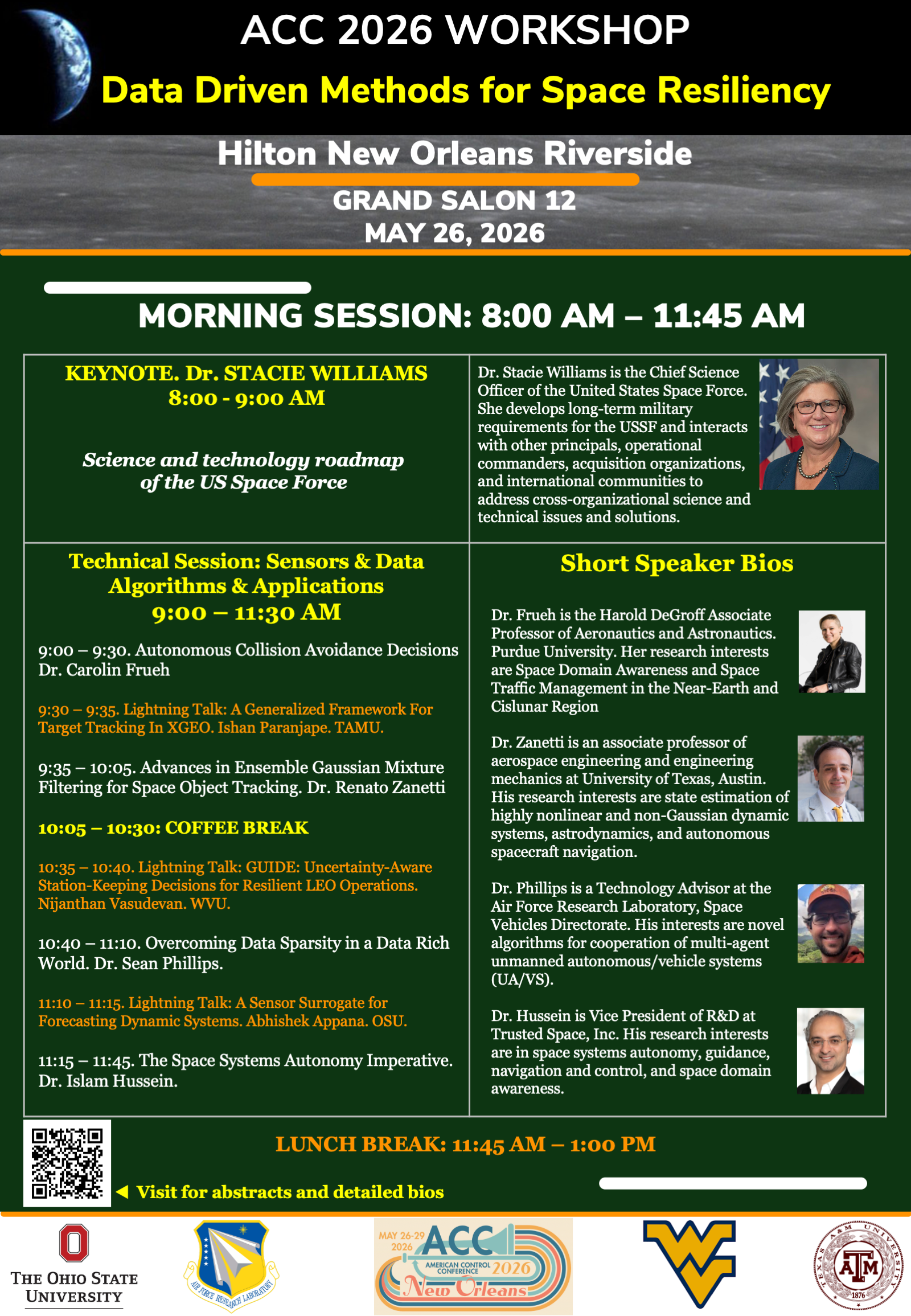
Keynote Address. 8 - 9 AM.
Dr. Stacie Williams, Chief Science Officer. United States Space Force.
Overview: Science and technology roadmap of the US Space Force.
Morning Session: Sensors and Data - Algorithms and Applications. 9 - 11:45 AM.
Dr. Carolin E. Frueh,
Harold DeGroff Associate Professor of Aeronautics and Astronautics. Purdue University.
Title: Autonomous Collision Avoidance Decisions
Abstract: Collision avoidance decisions, the decision of a manouver is performed in case of a potential conjunction, is crucial for the sustainable and safe use of space and spacecraft resilliancy. In this paper, we show that different organizations and entities reach vastly different decisions for the exact same conjunctions. In our approach we use a mixture of classical Dempster-Shafter decision making in combination with machine learning based methods. The data sets used a real data sets from two different space entities and simulated data which is able to reproduce all aspects of the real data.
Dr. Renato Zanetti, Associate Professor. The University of Texas at Austin.
Title: Advances in Ensemble Gaussian Mixture Filtering for Space Object Tracking
Abstract: This presentation explores recent advances in orbital mechanics estimation under sparse and unreliable data conditions, with a focus on nonlinear filtering and data fusion techniques. We introduce enhancements to the Ensemble Gaussian Mixture Filter (EnGMF), a hybrid approach combining particle and Gaussian mixture representations, tailored for systems with strong nonlinear dynamics and nonlinear measurements. A novel deterministic sampling method based on Projected Cramér–von Mises Distance is presented, offering improved accuracy and computational efficiency in high-dimensional filtering problems. Additionally, we discuss kernel-based modifications to the EnGMF for orbit determination in low Earth orbit and Cislunar environments, incorporating bi-fidelity propagation and adaptive particle selection to maintain estimation consistency with limited observations. Finally, we examine the role of posterior-based weight updates in Gaussian mixture filters, demonstrating their superiority over traditional prior-based methods in both single- and multi-target tracking scenarios. These contributions collectively advance the state of the art in space object tracking and estimation under challenging sensing conditions.
Coffee Break. 10:05 - 10:30 AM
Dr. Sean Phillips, Technology Advisor at the Air Force Research Laboratory.
Title: Overcoming Data Sparsity in a Data Rich World
Abstract: In a world completely subsumed by data, from the deployment of AI centers across the world to autonomous self-driving vehicles one can assume that proliferation of data is ubiquitous across all domains. However, there are still pockets where data is sparse and hard to obtain. Space is such an example. To increase the resilience of satellite systems there are two directions the space enterprise is going: 1) the development of proliferated low earth orbit satellite constellations and 2) the deployment of autonomous (or lights out) satellite operations. Therefore, due to many reasons the data required to train a closed loop autonomous satellite system continues to be prohibitively expensive. This talk will discuss several challenges in the space domain with respect to data, recent results from the AFRL Space Control Branch and how the Local Intelligent Network of Collaborative Satellites Lab is overcoming this challenge through terrestrial testing of satellite autonomy. Approved for public release; distribution is unlimited. Public Affairs release approval #AFRL20261658.
Dr. Islam Hussein,
Vice President of R&D. Trusted Space, Inc.
Title: The Space Systems Autonomy Imperative
Abstract: With the significant and constant growth in the number of spacecraft on orbit and in the number of associated on-orbit activities, operations in space are increasingly becoming more complex. With this increase in complexity, reliance on autonomous operations in space is not only a desirable option —it is now imperative. In this presentation, complexity will first be defined in terms of the (a) scale, (b) degree and type of uncertainty, and (c) degree of dynamism of both the space environment and the system. The goal of an autonomous system is to achieve mission objectives in a trusted and safe manner in the face of mission complexity. Trust encompasses both trust in the data ingested, and decisions generated by an autonomy capability. Safety refers to the need that an autonomy system keep critical internal health and orbital flight conditions away from undesirable, and potentially dangerous flight conditions. Closely related to the concept of safety is the notion of a co-safety requirement. Co-safety refers to the idea that decisions made by an autonomous system attain desirable mission effects. A trusted autonomous space system needs to assure that safety and co-safety requirements are met via deterministic and probabilistic formal methods and rigorous testing and evaluation. In this presentation, I will cover all of the above topics to make the case for the need to enhance space systems degree of autonomy in order to be able to operate in space safely and with trust.
Lunch Break & Open Mic. 11:45 AM - 1 PM.
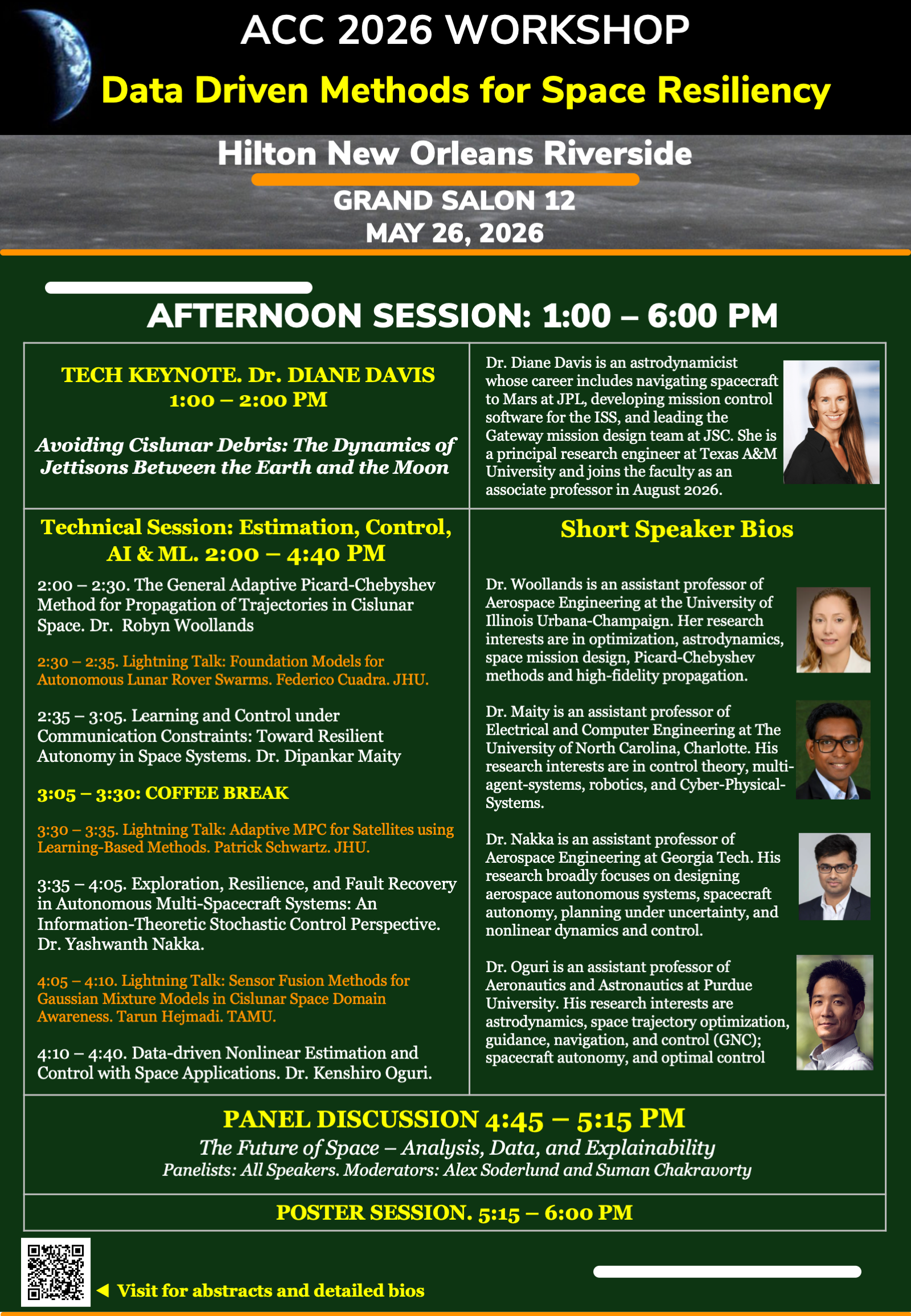
Technical Keynote Lecture. 1 - 2 PM.
Dr. Diane Davis, Associate Professor. Texas A&M University.
Title: Avoiding Cislunar Debris: The Dynamics of Jettisons Between the Earth and the Moon
Abstract: With the peaceful international exploration of cislunar space formalized in the Artemis Accords, increasing numbers of crewed and robotic spacecraft will be delivered beyond Earth orbit. Throughout the mission lifetime, it is critical to design safe paths for spacecraft components to avoid littering cislunar space with persistent debris that could threaten active vehicles, future missions, sensitive regions on the lunar surface, or the Earth. For example, launch vehicle upper stages may be disposed to heliocentric space; it may be desirable to jettison cubesats, docking covers or adapters, or other payloads during transits between the Earth and the Moon; and end-of-life plans for spacecraft that do not intend to return to Earth must be determined. The dynamical environment in cislunar space is significantly impacted by the simultaneous and complex gravitational influence of the Sun, Earth, and Moon, and designing safe disposal trajectories is nontrivial. This presentation focuses on the energy and epoch dependence of disposal trajectories during different phases along an Earth-Moon-Earth transit. Then, strategies are developed for maneuver designs that enable direct escape to heliocentric space and achieve long-term evasion of Earth for at least 100 years.
Afternoon Session: Estimation and Control, ML/AI for Space. 2 - 4:40 PM.
Dr. Robyn Woollands,
Assistant Professor. University of Illinois, Urbana-Champaign.
Title: The General Adaptive Picard-Chebyshev Method for Propagation of Trajectories in Cislunar Space
Abstract: A self-tuning general adaptive Picard–Chebyshev (GAPC) implicit integration method is presented for propagating trajectories in cislunar space. This work builds on the adaptive Picard–Chebyshev (APC) integrator which was designed for propagation of the weakly perturbed two-body problem and uses an adaptive segmentation strategy based on the true anomaly. However, this approach is not suitable for non-repeating trajectories in cislunar space, where the motion is dominated by two large bodies and the true anomaly is no longer available. GAPC automatically adapts segment length using normalized integration error estimates to satisfy user-defined error tolerances. Three scenarios are presented for quantifying the performance of the newly developed GAPC integrator. The first is a high-fidelity low Earth orbit (LEO) case, which enables direct comparison with the original APC method. The second is an orbit-boost scenario with continuous thrust applied in the local velocity direction. The third case is a long-duration propagation in cislunar space using the circular restricted three-body dynamics model. Across these cases, GAPC is compared with a Runge–Kutta-Feagin 12/10 integrator and a 15th-order implicit Gauss–Radau integrator, as well as with APC in the LEO scenario.
Dr. Dipankar Maity,
Assistant Professor. University of North Carolina at Charlotte.
Title: Learning and Control under Communication Constraints: Toward Resilient Autonomy in Space Systems
Abstract: Modern autonomous systems---from very low Earth orbit (VLEO) satellites to multi-agent spacecraft---depend critically on timely, reliable, and high-quality information exchange. Yet, space environments inherently impose severe communication constraints, including limited bandwidth, latency, packet loss, and quantization, which degrade both learning and control performance. This talk will present a unified framework for communication-aware control and learning, aimed at ensuring resilient operation of autonomous space systems under such adverse conditions.
Coffee Break. 3:05 - 3:30 PM
Dr. Yashwanth K. Nakka, Assistant Professor, Georgia Tech University.
Title: Exploration, Resilience, and Fault Recovery in Autonomous Multi-Spacecraft Systems: An Information-Theoretic Stochastic Control Perspective.
Abstract: Distributed spacecraft systems enable new capabilities in on-orbit inspection, distributed sensing, and cooperative exploration, but they introduce tightly coupled challenges in uncertainty-aware motion planning, information-driven sensing, and fault-tolerant operation. This talk presents a unified framework that integrates information-theoretic exploration for data collection, stochastic optimal control for safety under uncertainty, and fault detection, isolation, and recovery (FDIR) for resilient multi-spacecraft autonomy. We formulate sensing and motion planning as an information-cost stochastic nonlinear optimal control (Info-SNOC) problem, where spacecraft trajectories are optimized to maximize information gain while minimizing control effort and satisfying probabilistic safety constraints. The resulting chance-constrained stochastic optimal control problem is solved using generalized polynomial chaos (gPC) representations and sequential convex programming, enabling tractable trajectory generation for nonlinear stochastic dynamics with safety guarantees . We demonstrate that the proposed approach computes information-optimal inspection trajectories for multi-spacecraft formations, achieving improved target coverage while respecting fuel and safety constraints in coordinated inspection missions. In addition, we introduce an information-driven FDIR framework that detects and identifies actuator and sensor faults by monitoring deviations in global task metrics and probabilistic residuals between predicted and observed system behavior. Simulation studies show that the approach can reliably detect and classify multiple fault modes while maintaining mission objectives through adaptive reconfiguration. These results provide a principled architecture for resilient multi-spacecraft exploration (data - collection) under uncertainty and system degradation.
Dr. Kenshiro Oguri, Assistant Professor. Purdue University.
Title: Data-driven Nonlinear Estimation and Control with Space Applications.
Abstract: In this talk, I will present our recent results on data-driven methods and their applications to spacecraft autonomy and space domain awareness (SDA). The developed methods leverage tools from statistics, non-Gaussian inference, optimal control, and convex/non-convex optimization for nonlinear estimation and control relevant to space operations. Even though the dynamical environment in space is often well-characterized by orbital mechanics, the analysis, forecast, and control of orbit uncertainty are challenging due to the nonlinear gravity and its chaotic nature in multi-body settings (e.g., cislunar space). The challenge is further compounded when we do not have direct access to, but need to infer, the intension and capability of potentially maneuvering space objects. The presented methods address these challenges by taking the best of two worlds: analytical expression of available models and scalability of data-driven methods.
Panel Discussion. 4:45 - 5:15 PM.
Details coming soon.
Poster Session and Closeout. 5:15 - 6 PM.